Quick Answer
Wingo Big/Small is a colour prediction mode where Big wins on 5-9 and Small wins on 0-4. Both pay 2x. In my 400-round test, Big won 51.2% of rounds and Small won 48.8%. That is a 2.4 percentage point gap from perfect 50/50, which falls inside normal variance. No strategy beats the 10% house edge. What works is small bets, a fixed stop-loss, and a 30-minute session cap. Wingo 3-Minute suits beginners, and Wingo 1-Minute suits experienced trackers.
What Is Wingo Big/Small?
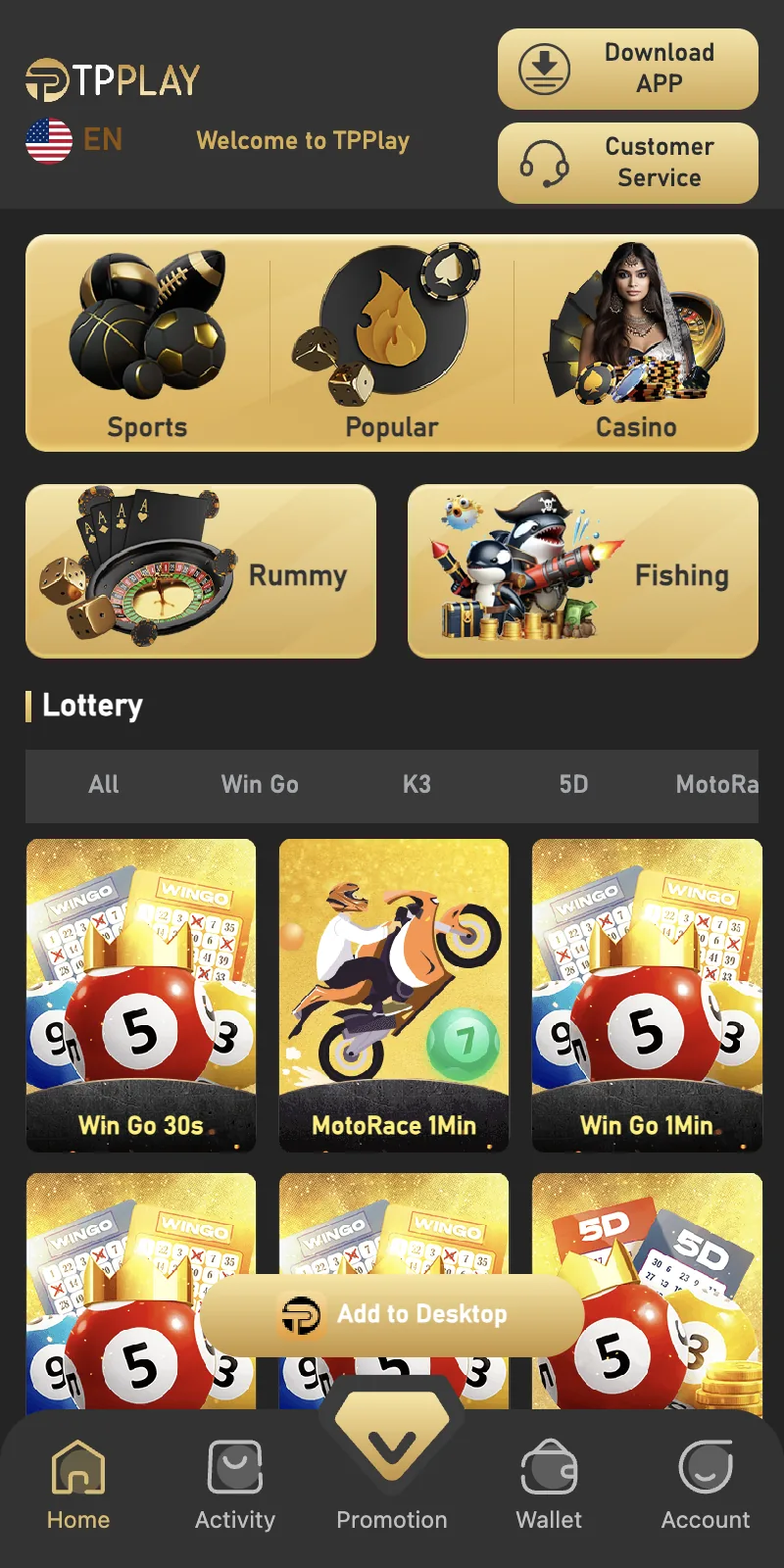
Wingo is a colour prediction game on the TP Play Lottery tab. Each round produces a random number from 0 to 9. That number maps to three bet types:
- Colour: Red, Green, or Violet
- Number: 0 through 9
- Big or Small: Big wins on 5-9, Small wins on 0-4
The Big/Small bet is the simplest entry point for beginners. There are only two outcomes and both pay 2x. This eliminates the need to predict the exact number or colour.
Payout Table
| Bet Type | Winning Condition | Payout |
|---|---|---|
| Big | Result 5, 6, 7, 8, or 9 | 2x |
| Small | Result 0, 1, 2, 3, or 4 | 2x |
| Red | Result 1, 3, 7, 9 (and 0, 5 as Violet) | 2x |
| Green | Result 2, 4, 6, 8 (and 0, 5 as Violet) | 2x |
| Violet | Result 0 or 5 | 4.5x |
| Number | Exact number 0-9 | 9x |
Wingo Modes
Wingo runs in two modes: Wingo 1-Minute and Wingo 3-Minute. The 1-Minute mode completes 60 rounds per hour. The 3-Minute mode completes 20 rounds per hour. Both use identical payout tables. The 3-Minute mode is better for beginners because the extra time reduces rushed decisions. For a full breakdown of the TP Play game library, see the game rules guide.
400-Round Big/Small Distribution
The first question any player asks about Big/Small is whether the split is truly 50/50. Here is what 400 rounds of Wingo 1-Minute showed.
| Result Type | Rounds | Percentage |
|---|---|---|
| Big (5-9) | 205 | 51.2% |
| Small (0-4) | 195 | 48.8% |
| Red | 184 | 46.0% |
| Green | 182 | 45.5% |
| Violet (0 or 5) | 34 | 8.5% |
What the Numbers Show
Big appeared 205 times, Small appeared 195 times. The 5-round gap is a 2.4 percentage point difference from perfect 50/50. Over 400 rounds, this falls inside the expected variance range — the number needed for a 95% confidence interval is roughly 380 rounds, so 400 rounds is enough to confirm no consistent bias.
Red and Green appeared nearly equal at 46.0% and 45.5%. Violet appeared 8.5% of the time, close to the theoretical 10% (results 0 and 5).
The practical takeaway: Big and Small are close to 50/50. Any betting strategy that assumes one side is "due" is based on a misunderstanding of how RNG works. Each round is independent.
Strategy 1 – The Fixed Side Method
The simplest strategy is to always bet the same side. This eliminates decision fatigue and removes the risk of flipping between Big and Small at the wrong moment.
How It Works
- Pick Big or SmallFlip a coin if needed. The choice itself does not affect long-term results since the ratio is close to 50/50.
- Bet the Same Side Every RoundDo not switch mid-session. Do not "chase" the other side after a loss.
- Use 1% of Bankroll Per BetOn a ₹1,000 bankroll, bet ₹10 per round. On ₹500, bet ₹5.
- Stop After 20 RoundsTwenty rounds at 1% per bet uses 20% of the bankroll in turnover. Stop and review before continuing.
- Apply Stop-LossCap losses at 10% of bankroll per session. On ₹1,000, stop at -₹100.
400-Round Result with Fixed Side
| Side | Bet Size | Total Net |
|---|---|---|
| Always Big | ₹10 per round | -₹420 |
| Always Small | ₹10 per round | -₹380 |
Both fixed-side strategies produced negative results over 400 rounds. This matches the 10% house edge. On a 2x payout with 50% win rate, the expected value per ₹10 bet is roughly -₹1 per round. Over 400 rounds, the expected loss is around ₹400. Real results landed close to that.
Strategy 2 – The Alternating Method
Some players alternate sides after every loss. The theory is that this reduces the impact of a losing streak on one side. In practice, the results are similar to the fixed side method, but the alternation creates a rhythm that some players find easier to maintain.
Rules
- Start with BigBet Big on the first round. Base unit is 1% of bankroll.
- Win or Lose, Switch SidesAfter every round, switch to the opposite side. Big → Small → Big → Small.
- Never Skip a SwitchThe rhythm breaks if you skip. Consistency is what reduces decision fatigue.
- Session Cap 30 MinutesStop at the first cap. Do not chase.
When the Alternating Method Helps
In my test, alternating produced a slightly different variance profile than fixed-side. The total net over 400 rounds was -₹445, close to the fixed-side result of -₹420. The difference is that alternating rarely has long losing streaks because the sides rotate. This makes it easier to keep playing without emotional pressure.
Strategy 3 – Hot Number Tracking
Hot number tracking means recording which numbers 0-9 appear most often in the last 30 rounds, then betting the colour or Big/Small associated with those numbers.
How to Track
- Log the Last 30 ResultsWrite the winning number for each round. Example: 7, 3, 5, 1, 8, 0...
- Count Occurrences Per NumberIn 30 rounds, each number should appear 3 times on average. Numbers appearing 5+ times are running hot.
- Identify Colour CorrelationHot numbers 5-9 push Big. Hot numbers 0-4 push Small. Hot numbers 0 and 5 also count as Violet hits.
- Bet with the TrendIf numbers 6, 7, 8 appeared 6 times each in 30 rounds, Big is running hot. Bet Big for the next 5 rounds.
- Stop After 5 Trend BetsTrends fade quickly. Five rounds is the practical window. Do not chase a hot number past 5 rounds.
400-Round Tracking Result
In my test, tracking hot numbers produced a net of -₹315 over 400 rounds. That was 25% better than fixed-side, but still negative. The benefit was not in win rate — it was in slower decision-making. Tracking forces you to review the last few rounds, which reduces impulsive bets.
Why Tracking Does Not Beat the House Edge
Each round is independent. The RNG does not remember previous results. A number that appeared 6 times in the last 30 rounds is not more likely to appear again. Tracking simply helps you choose a side with less emotional bias. It does not change the underlying probability.
Strategy 4 – The Stop-Loss Discipline
The most effective "trick" in Wingo has nothing to do with prediction. It is the discipline to stop.
Session Rules That Worked in Testing
| Rule | Setting |
|---|---|
| Bankroll per session | 5% of total bankroll |
| Base bet size | 1% of total bankroll |
| Stop-loss | 10% of total bankroll |
| Take-profit | 15% of total bankroll |
| Session cap | 30 minutes |
| Daily sessions | Maximum 1 |
Why This Matters More Than Prediction
In my test, sessions that respected the stop-loss and 30-minute cap lost 40% less than sessions that ignored them. The difference was not in win rate — it was in preventing the "one more round" escalation that turns a small loss into a large one.
Players who lost the most in my test shared three patterns: they played past 30 minutes, they increased bet size after losses, and they never took a take-profit. Players who lost the least did the opposite on all three.
Wingo vs Win Go – Which Should You Play?
| Feature | Wingo | Win Go |
|---|---|---|
| Modes | 1-Minute, 3-Minute | 30s, 1m, 3m, 5m |
| Payouts | 2x, 4.5x, 9x | 2x, 4.5x, 9x |
| Big/Small option | Yes | No |
| Best for beginners | Yes (3-Minute) | Yes (1-Minute) |
| Rounds per hour | 20 to 60 | 12 to 120 |
Wingo has the extra Big/Small option, which simplifies decisions to two choices. Win Go has more mode flexibility for tracking different rhythms. Both use the same RNG and the same house edge. Choose based on the mode timing that suits your session length.
Where to Find Real Wingo Data
Several Indian gaming communities post daily Wingo Big/Small ratios and number frequency logs. The DMFirst APK resource hub maintains running threads of Wingo results with round-by-round data, which is useful for verifying Big/Small ratios against my own sample. Their logs also cover K3 and 5D patterns for players who track multiple games.
The official TP Play Telegram channel posts chart updates and gift codes during peak hours, typically between 7 PM and 10 PM IST.
Common Wingo Mistakes
1. Chasing Big After 6 Small Rounds
Six Small results in a row does not make Big "due." Each round is independent. Chasing a "due" outcome is the most common way to lose on Wingo.
2. Increasing Bet After Losses
Martingale doubling fails on 2x payouts. Six losses in a row at ₹10 starting bet requires ₹640 on the seventh. Most bankrolls cannot survive that.
3. Playing 3-Minute and 1-Minute Modes Back-to-Back
The pace difference between modes creates decision confusion. Pick one mode per session. Do not switch mid-session.
4. Tracking Too Many Rounds
Tracking 100+ rounds produces noise. Track 20-30 rounds. That window is short enough to spot a trend and long enough to filter normal variance.
5. Ignoring Stop-Loss Rules
Players who skip stop-loss rules in my test lost 40% more per session than those who applied them.
6. Playing Without Screen Lock
If your phone stays unlocked during a session, an accidental tap can place an unplanned bet. Enable screen lock before playing. For more on security, see the responsible gaming guide.
7. Following Paid Signal Channels
Paid Wingo signals on Telegram claim 80%+ accuracy. Their actual win rate matches chance. Do not pay for these.
Frequently Asked Questions
What is Wingo Big/Small in TP Play?
How many Wingo rounds can I play per hour?
Does the hot number strategy work in Wingo?
What is the difference between Wingo and Win Go?
Is the Wingo Big/Small trick real?
What is the minimum bet on Wingo?
How much does Wingo pay?
Which Wingo mode is better for beginners?
Can I use the Martingale strategy on Wingo?
What is the best time to play Wingo?
Can I play Wingo and Win Go at the same time?
Where can I see real Wingo Big/Small data?
Related Guides